
A purpose-built UAV 100Km wireless data link system leveraging COFDM MIMO technology and Mesh self-organizing networks to deliver beyond-line-of-sight coverage for multi-rotor UAV operations. The 1.2GHz frequency band and high-gain antennas extend air-to-ground range past 100km with 4K streaming and millisecond-level latency.

Core Networking Architecture
Decentralized Mesh topology with multi-hop relay capability is the distance breakthrough key for UAV 100Km wireless data link, video data transmission.
Center-Less Mesh Ad Hoc
Drones, ground stations, and relay nodes share equal status with no base station dependency. Power on and the network auto-forms. Dynamic routing calculates optimal paths in real-time based on signal strength, latency, and bandwidth.
Self-Healing Network
When a node fails or moves out of range, the Mesh reconstructs within 100ms without communication interruption. Multi-hop paths automatically activate when single-hop links are blocked, extending coverage radius by over 15x.
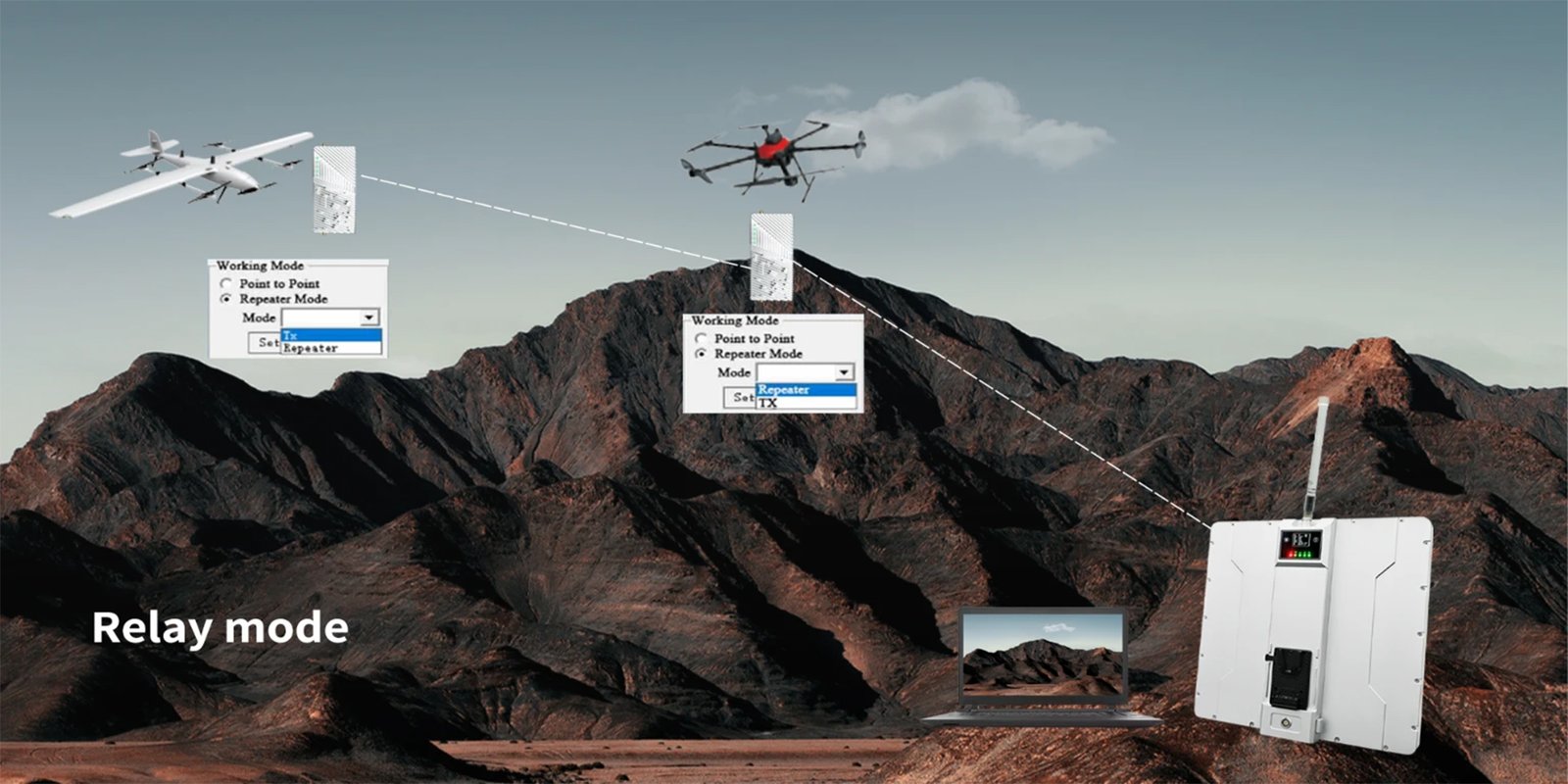
Air Relay Networking
Single drone relays forward ground signals to obstructed areas, increasing coverage 3-5x. Multi-machine chain relays with 2-3 drones in series achieve 100km+ over-the-horizon transmission with ≥30% signal overlap between nodes.
AES-256 Encryption
End-to-end AES-256 encryption secures video streams and telemetry data without impacting transmission efficiency. Frequency hopping and spread spectrum compensate for over 50% distance attenuation in complex electromagnetic environments.
High-Speed Transmission Core Technology
COFDM modulation, MIMO spatial diversity, and adaptive coding combine to deliver bandwidth and stability across 100km+ links.
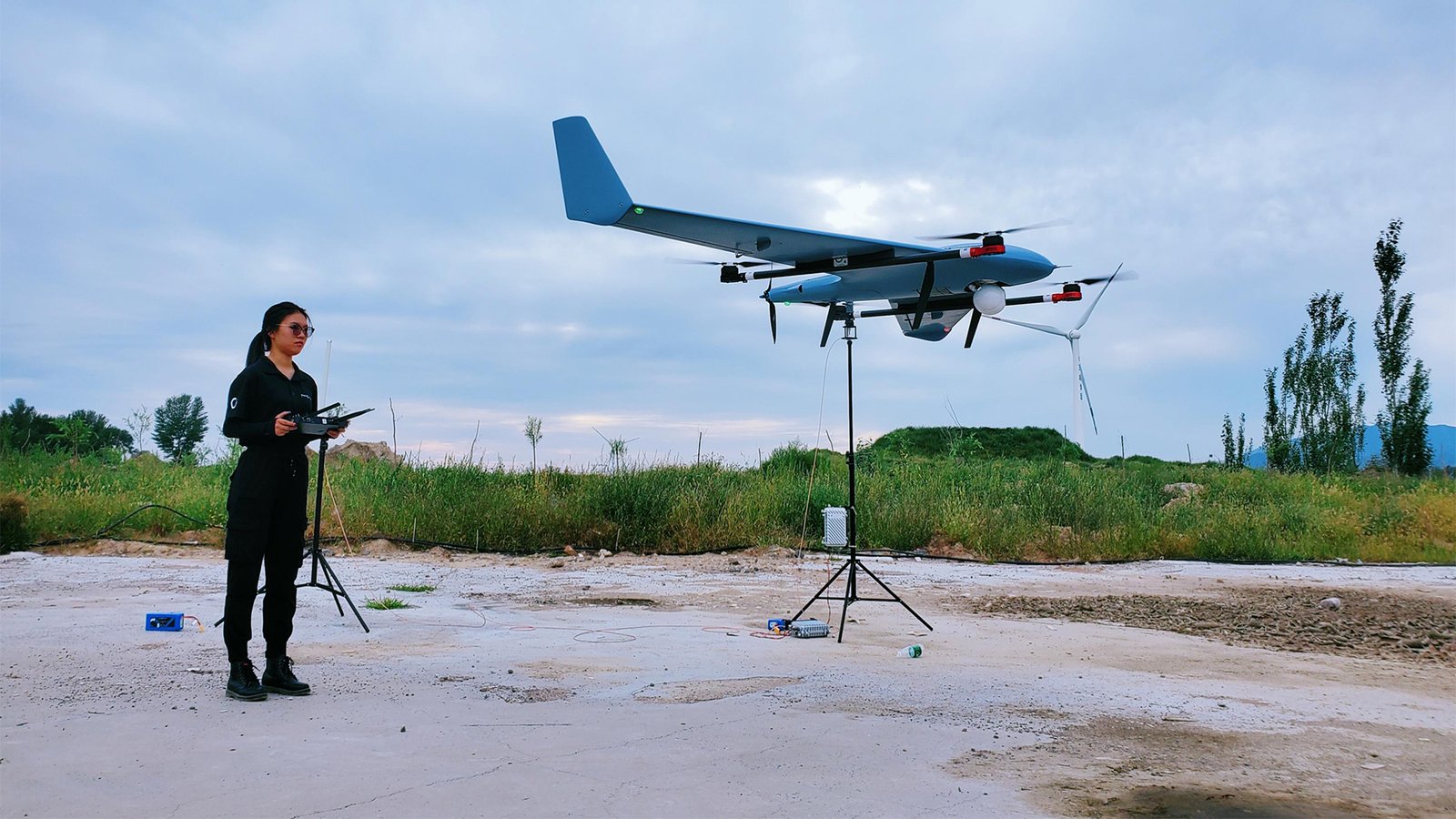
COFDM + MIMO + Adaptive Coding
COFDM splits high-speed data into multiple low-speed sub-carriers, making the signal resistant to multi-path fading and occlusion—critical for non-line-of-sight scenarios. MIMO (2T2R/4T4R) adds 5-8dB spatial diversity gain and doubles channel capacity, achieving peak speeds up to 108Mbps under 40MHz bandwidth.
Adaptive Modulation and Coding (AMC) dynamically selects 64QAM/256QAM when channel quality is strong and drops to QPSK when reliability is paramount. FEC forward error correction reduces bit error rates over long distances, ensuring data integrity across the entire UAV 100Km wireless data link chain.
- COFDM: multi-carrier modulation resistant to multi-path fading
- MIMO 2T2R/4T4R: 5-8dB spatial diversity gain
- AMC: 64QAM/256QAM for speed, QPSK for reliability
- FEC: forward error correction for weak signal integrity
- Frequency hopping / spread spectrum for EMI resilience

Frequency & Antenna Optimization
The 1.2GHz/1.4GHz UHF/L-band offers longer wavelength, stronger diffraction, and smaller Fresnel zones—ideal for 100km+ line-of-sight transmission. A 5.8GHz backup band provides large bandwidth and anti-interference capability for high-definition video, with dual-band intelligent switching ensuring link stability.
Airborne omnidirectional antennas (5-8dBi) provide maneuverability while ground directional parabolic antennas (23-30dBi) extend range an additional 30-50%. Adaptive power control (0.1-10W dynamic adjustment) balances coverage, range, and electromagnetic concealment. Receiver sensitivity optimization reaches -100 to -103dBm for stable reception even under weak signals.
- Primary: 1.2GHz/1.4GHz for diffraction and long-range
- Backup: 5.8GHz for bandwidth and anti-interference
- Airborne: 5-8dBi omnidirectional FRP antennas
- Ground: 23-30dBi directional parabolic antennas
- Adaptive power: 0.1-10W dynamic adjustment
- Receiver sensitivity: -100 to -103dBm
Typical Implementation Plan
From airborne radios to complete 100km ultra-long-distance architectures, the solution scales to mission requirements.
Airborne Self-Organizing Network Radio
The ST99/ST96 series delivers lightweight performance (≤400g) with 2W COFDM+Mesh output and full IP interface. Air-to-ground line-of-sight reaches 50-100km with end-to-end latency under 50ms, supporting 1080P/4K high-definition video transmission.
When integrated with a ground control station and antenna tracking system, the airborne radio forms the aerial node of a complete integrated UAV 100Km wireless data link ecosystem. For extended missions, portable power stations ensure sustained operation in remote deployment zones.
- Weight: ≤400g with 2W COFDM+Mesh output
- Range: 50-100km air-to-ground line-of-sight
- Latency: <50ms end-to-end
- Video: 1080P/4K HD streaming support
- Interface: Full IP with Ethernet connectivity
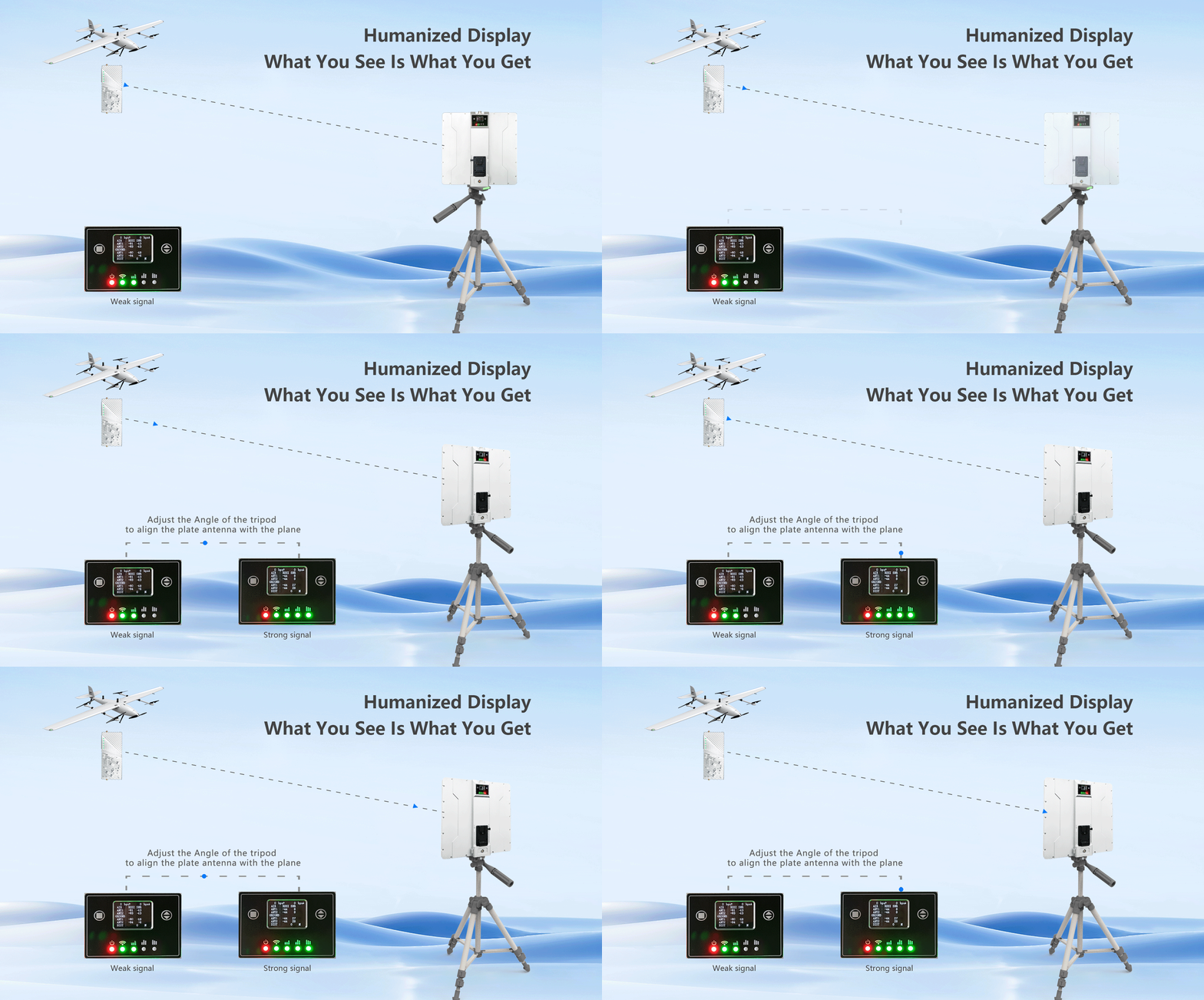
100km Ultra-Long Distance Architecture
The complete solution deploys a ground station plus 1-2 relay drones and operational aircraft in a chain/mesh network. The 1.2GHz main link pairs with a 5.8GHz backup, MIMO and high-gain antennas handle multi-hop relay, and performance metrics hold steady at 1080P@60fps with ≤100ms latency, ≥4Mbps data rate, and ≤10⁻⁶ error rate.
UAV 100Km wireless data link key deployment considerations: relay drone altitude ≥1000m for Fresnel zone clearance; 1.2GHz/1.4GHz prioritized for distance with 5.8GHz supplementing bandwidth; airborne omnidirectional for maneuverability and ground directional for gain; dynamic load balancing enabled to prevent single-node congestion.
- Architecture: Ground + 1-2 relay drones + operational aircraft
- Network: Chain/mesh with 1.2GHz main + 5.8GHz backup
- Performance: 1080P@60fps, ≤100ms latency, ≥4Mbps
- Relay altitude: ≥1000m for line-of-sight clearance
- Dynamic load balancing across all nodes
Related SoarApex Systems
Build a complete long-range unmanned communication ecosystem with our integrated solutions.
External Resources
Technical references and industry standards for long-range UAV 100Km wireless data link video transmission and Mesh networking.
Comprehensive overview of coded orthogonal frequency division multiplexing technology principles.
Multiple-input multiple-output wireless communication standards and spatial diversity gains.
International Telecommunication Union standards for radio frequency spectrum and UAV communications.
Open-source micro air vehicle communication protocol for telemetry and command links.
IEEE standards for wireless communication systems, modulation techniques, and network protocols.
Deploy 100km Video Transmission Today
The UAV 100Km wireless data link, UAV video data transmission solution is available now through SoarApex. Contact us for system architecture design, compatibility verification, and complete long-range communication ecosystem quotes.
Request a Quote