
The smart 45km range AAT system utilizes antenna arrays and digital signal processing to dynamically adjust beam direction through adaptive algorithms. Coherent signal superposition enhances transmission toward the target while cancelling interference from other directions—delivering reliable data link connectivity for multi-rotor UAV operations beyond visual line of sight.
How the 45km Range AAT System Works
Automatic antenna tracking 45km range AAT system dynamically orient high-gain directional antennas toward airborne platforms, maximizing signal strength and link stability across extended distances.
Adaptive Beamforming Technology
The core working principle of the 45km range AAT system lies in adaptive beamforming. By adjusting the phase and amplitude of signals transmitted by each antenna unit in the array, the system achieves coherent superposition and enhancement in the direction of the target UAV while cancelling and weakening signals from other directions.
This digital signal processing approach enables the 45km range AAT system to maintain precise alignment with the airborne platform throughout its flight trajectory. The result is a stable, high-bandwidth integrated data link that outperforms static omnidirectional solutions by approximately 20% in both signal strength and transmission bandwidth.
- Dynamic beam direction adjustment via adaptive algorithms
- Phase and amplitude control per antenna array element
- Coherent signal enhancement toward target direction
- Interference cancellation from off-axis sources
- Real-time tracking without manual alignment
42km Field Test Validation
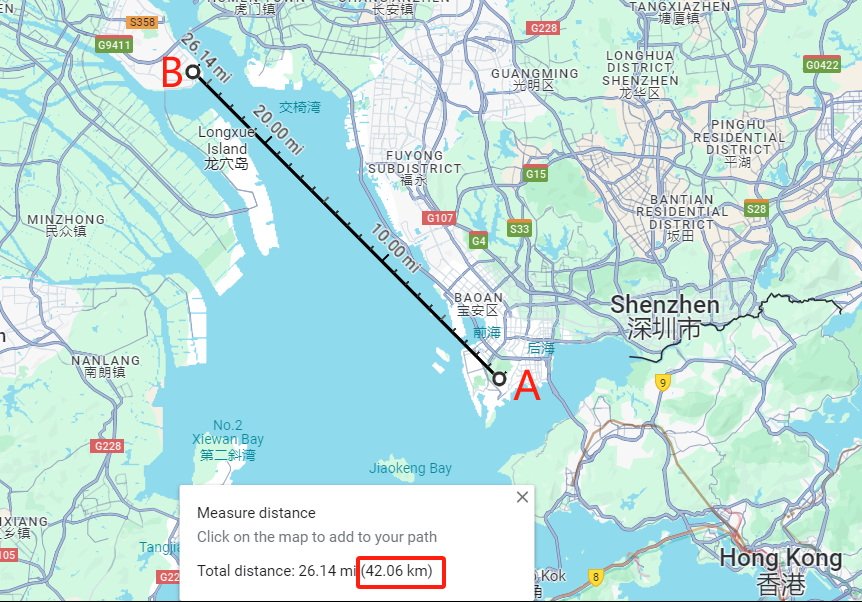
Real-world transmission performance testing between Shenzhen South Mountain and Guangzhou Nansha waterfront—an unobstructed open-sky environment spanning 42.06 kilometers.
Test Environment & Configuration
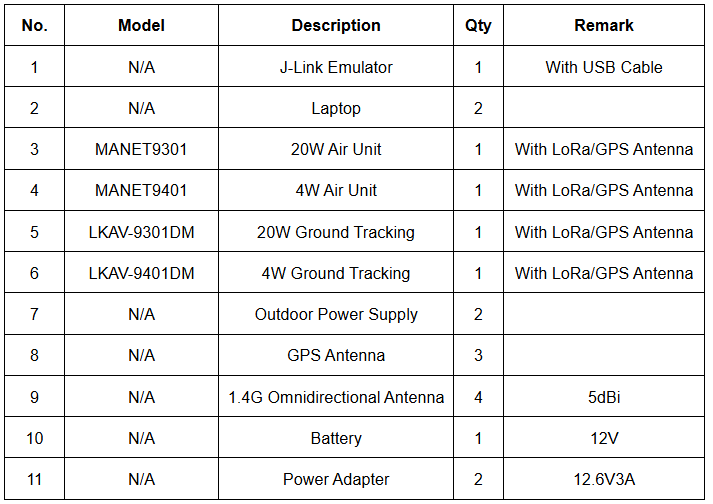
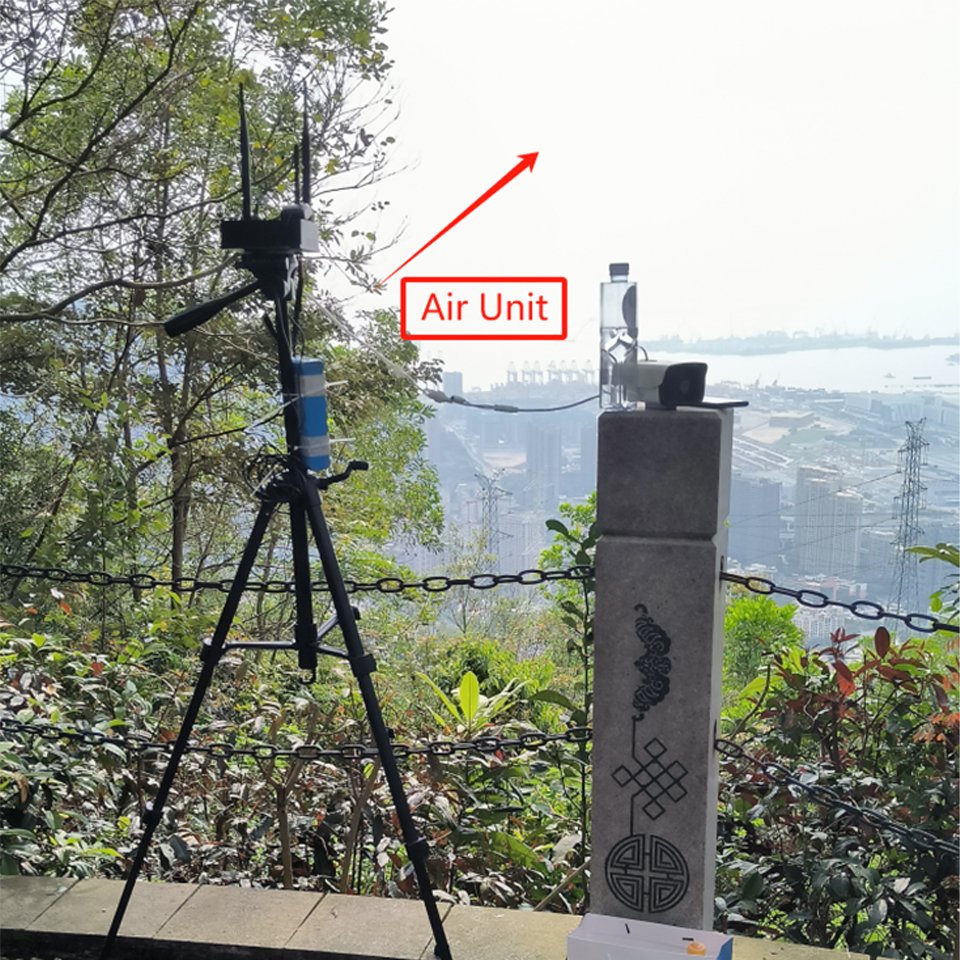
The air unit was installed at the Shenzhen South Mountain Observation Deck and connected to a laptop for stream testing. The ground 45km range AAT system was positioned at the Guangzhou Nansha waterfront and connected to a receiving computer for bandwidth and signal quality analysis.
Test parameters were configured for long-range validation: 1410MHz frequency, 10MHz bandwidth, and 4W/20W output power options. The Google Maps-measured distance between Point A (ground station) and Point B (air unit) was 42.06 kilometers—well within the 45km range specification of the AAT system.
- Air Unit: 5dBi omnidirectional FRP antenna × 2
- Ground Tracking: 14dBi directional panel + 6dBi omnidirectional FRP
- Alternative Ground: 2× 5dBi omnidirectional FRP antennas
- Frequency: 1410MHz | Bandwidth: 10MHz
- Power: 4W (9401 series) / 20W (9301 series)
Device Power Comparison Matrix
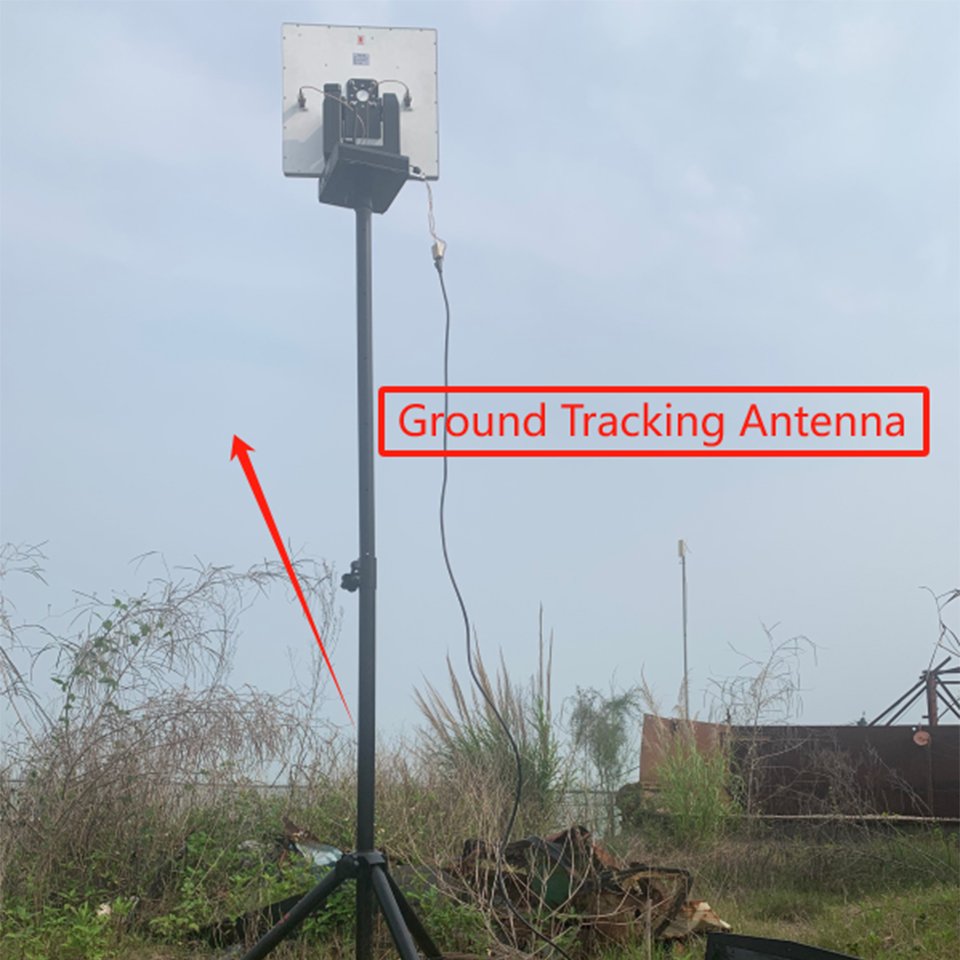
To isolate the impact of transmitter power on long-range performance, four device combinations were tested across the 42km link:
9401 (4W Air Unit) ↔ 9301DM (20W Ground Tracking) — asymmetric low-to-high power
9401 (4W Air Unit) ↔ 9401DM (4W Ground Tracking) — symmetric low power
9301 (20W Air Unit) ↔ 9301DM (20W Ground Tracking) — symmetric high power
9301 (20W Air Unit) ↔ 9401DM (4W Ground Tracking) — asymmetric high-to-low power
When paired with a ground control station and portable power station for extended field operations, this AAT system enables reliable beyond-visual-line-of-sight missions for multi-rotor UAV platforms.
| Air Unit | Ground Unit | Air Antenna | Ground Antenna | Bandwidth Result |
|---|---|---|---|---|
| 9401 (4W) | 9301DM (20W) | 2× 5dBi FRP | 1× 14dBi Panel + 1× 6dBi FRP | High — directional gain optimized |
| 9401 (4W) | 9401DM (4W) | 2× 5dBi FRP | 2× 5dBi FRP | Baseline — omnidirectional reference |
| 9301 (20W) | 9301DM (20W) | 2× 5dBi FRP | 1× 14dBi Panel + 1× 6dBi FRP | Maximum — dual high-power + directional |
| 9301 (20W) | 9401DM (4W) | 2× 5dBi FRP | 2× 5dBi FRP | Moderate — air power dominates |
Test Conclusions
Data-driven insights from the 42km validation test reveal critical performance differentiators for long-range 45km range AAT system deployment.
Directional vs. Omnidirectional Performance
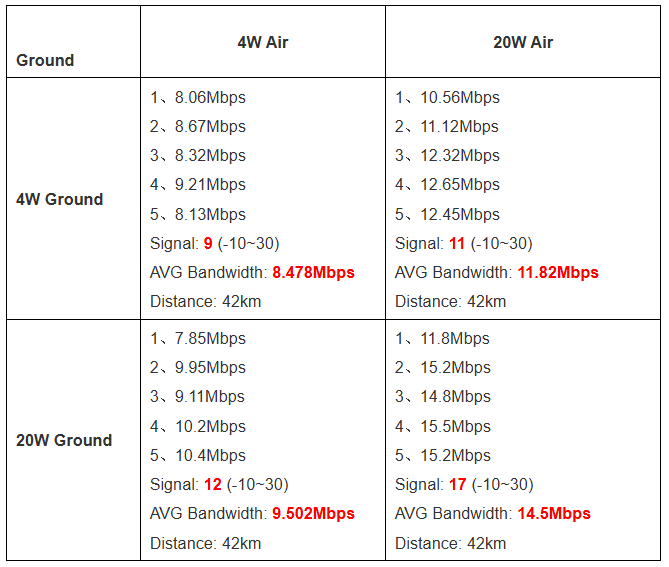
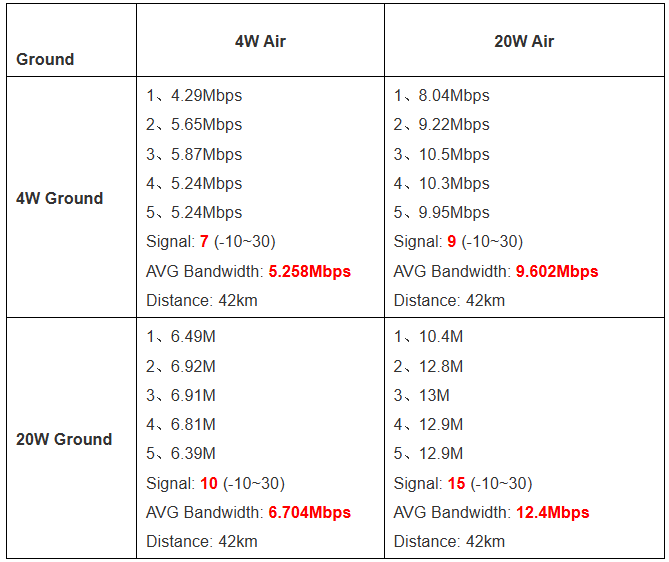
The 45km range AAT system test data confirms that directional antennas deliver significantly higher bandwidth and superior signal quality compared to omnidirectional configurations. The 14dBi directional panel antenna increased bandwidth and signal strength by approximately 20% over the 5dBi omnidirectional FRP alternative.
From a device power perspective, the air unit’s output has the more pronounced impact on link performance. The bandwidth differential between 4W and 20W air units exceeded 6 Mbps—substantially greater than the 1–2 Mbps variance observed between 4W and 20W ground units. This finding informs optimal system pairing: investing in higher-power air units yields greater returns for long-range data link stability than equivalent ground-side upgrades.
- Directional antennas: ~20% bandwidth and signal strength improvement
- Air unit power (4W vs 20W): >6 Mbps bandwidth differential
- Ground unit power (4W vs 20W): ~1–2 Mbps bandwidth differential
- Optimal pairing: high-power air unit + directional ground tracking
Ecosystem Integration
The 45km range automatic antenna tracking system integrates seamlessly with SoarApex unmanned infrastructure for complete mission coverage.
Complete Unmanned Mission Architecture
For operators deploying multi-rotor UAV drones on extended-range missions, the 45km AAT system forms the critical communication backbone. When combined with a ground control station for command and telemetry, antenna tracking systems for precision alignment, and SoarApex power stations for sustained field operations, the ecosystem delivers uninterrupted connectivity from takeoff to landing.
The tracking system mounts on a standard tripod for rapid deployment and supports both 14dBi directional panel antennas for maximum range and 6dBi omnidirectional FRP antennas for flexible coverage. This modularity allows operators to adapt the integrated data link configuration to mission-specific range and mobility requirements.
- Tripod-mounted tracking head for rapid field deployment
- Compatible with 4W and 20W air/ground unit combinations
- Dual-antenna configuration: directional + omnidirectional
- Seamless integration with GCS, UAV platforms, and power systems
- Open-sky environment optimized; obstacle-aware positioning
Related SoarApex Systems
Build a complete long-range unmanned communication ecosystem with our integrated solutions.
External Resources
Technical references and industry standards for automatic 45km range AAT system and long-range UAV communications.
Comprehensive overview of adaptive beamforming technology and phased array antenna principles.
International Telecommunication Union standards for radio frequency spectrum allocation and usage.
IEEE standards for antenna measurement, radiation patterns, and communication system performance.
Federal Aviation Administration guidelines for beyond-visual-line-of-sight UAV operations and data link requirements.
Open-source micro air vehicle communication protocol for telemetry and command links in UAV systems.
Extend Your UAV Range to 45km
The 45km range AAT system is available now through SoarApex. Contact us for system configuration, compatibility verification, and complete long-range communication ecosystem quotes.
Request a Quote