
Beyond Visual Line of Sight (BVLOS) communication requires more than single-hop direct connections. Our 100Km Wireless UAV Video Data solutions combine 1.4GHz frequency bands, high-power radio devices, Mesh self-organizing networks, and COFDM modulation to deliver stable, long-range connectivity for VTOL fixed-wing platforms, multi-rotor UAV drones, and ground control infrastructure.

Mesh Self-Organizing Multi-Hop Relay
The most mainstream and robust solution for achieving 100Km Wireless UAV Video Data coverage. By breaking through single-point distance limitations through intelligent relay, this architecture excels in complex terrains.

Operating Principle
The signal flows through a chain: Point A → Point B (Relay) → Point C (Reception). Each hop covers approximately 30–50km, meaning 2–3 hops can effectively extend coverage to 100km+.
When deployed with command control terminals, operators gain real-time visibility into network topology and link health across the entire relay chain.
- Self-Healing Links: Automatically switches paths when a single node fails
- Dynamic Topology: Supports drone clusters and mobile platforms
- Scalability: Networks support 32–256 decentralized nodes
- Redundancy: Multiple available paths eliminate single-point failures
- Cascade Delay: Multi-hop relay controlled within 50–100ms
Dedicated Frequency Band Direct Connection
In scenarios with excellent visibility—open sea surfaces and flat plains—high-power private network radio stations establish direct 100Km Wireless UAV Video Data connections with minimal latency.
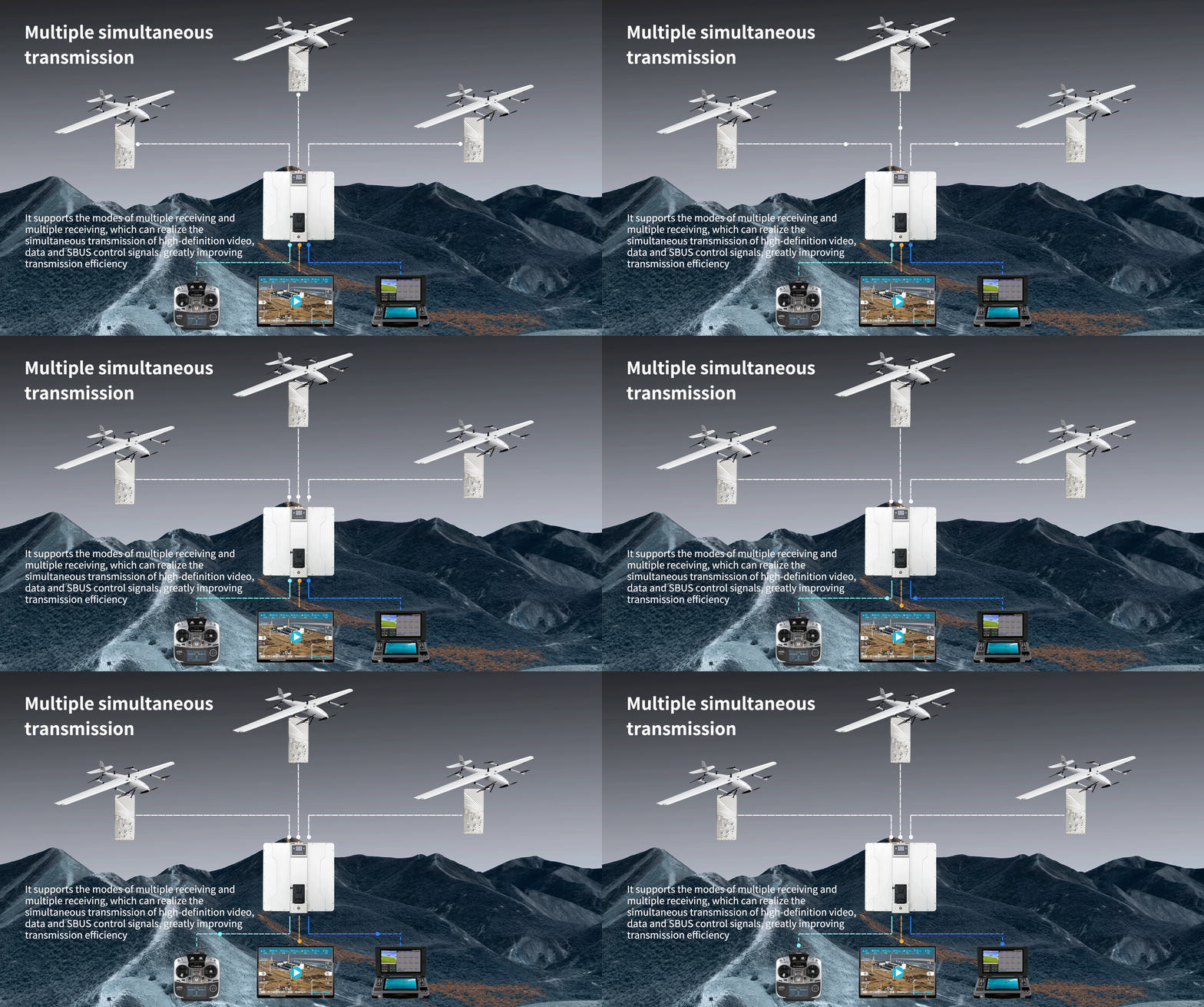
1.4GHz Industrial Private Network
The 1.4GHz band (1350–1450MHz) is the optimal choice for 100Km Wireless UAV Video Data applications. Compared to crowded 2.4GHz/5.8GHz consumer bands:
- Longer wavelength provides superior diffraction capability
- Transmission loss is more than 40% lower than 2.4GHz/5.8GHz
- Better performance in long-distance and slightly obstructed environments
- Less interference from consumer Wi-Fi and Bluetooth devices
Alternative: 600MHz–900MHz offers stronger penetration but lower bandwidth, ideal for pure data telemetry rather than HD video.
| Parameter | Specification | Notes |
|---|---|---|
| Transmission Range | Up to 150km (optimal conditions) | Requires clear line-of-sight and high-gain antennas |
| Concurrent Channels | Video, telemetry, control commands | Independent logical channels eliminate bandwidth contention |
| End-to-End Latency | < 30 milliseconds | Essential for precision flight maneuvers |
| Network Topology | One-to-many, many-to-one, relay | Flexible dual-link mode architecture |
| Anti-Interference | Automatic frequency hopping | Mitigates co-channel interference and jamming |
| Bandwidth | 10–90Mbps | Supports 1080P/60fps video transmission |
| Receiving Sensitivity | < -110dBm | Ensures weak signal decoding at 100km range |
Ground Fixed Relay Station
For fixed infrastructure requiring long-distance backhaul—offshore wind farms, border monitoring, and permanent surveillance posts.
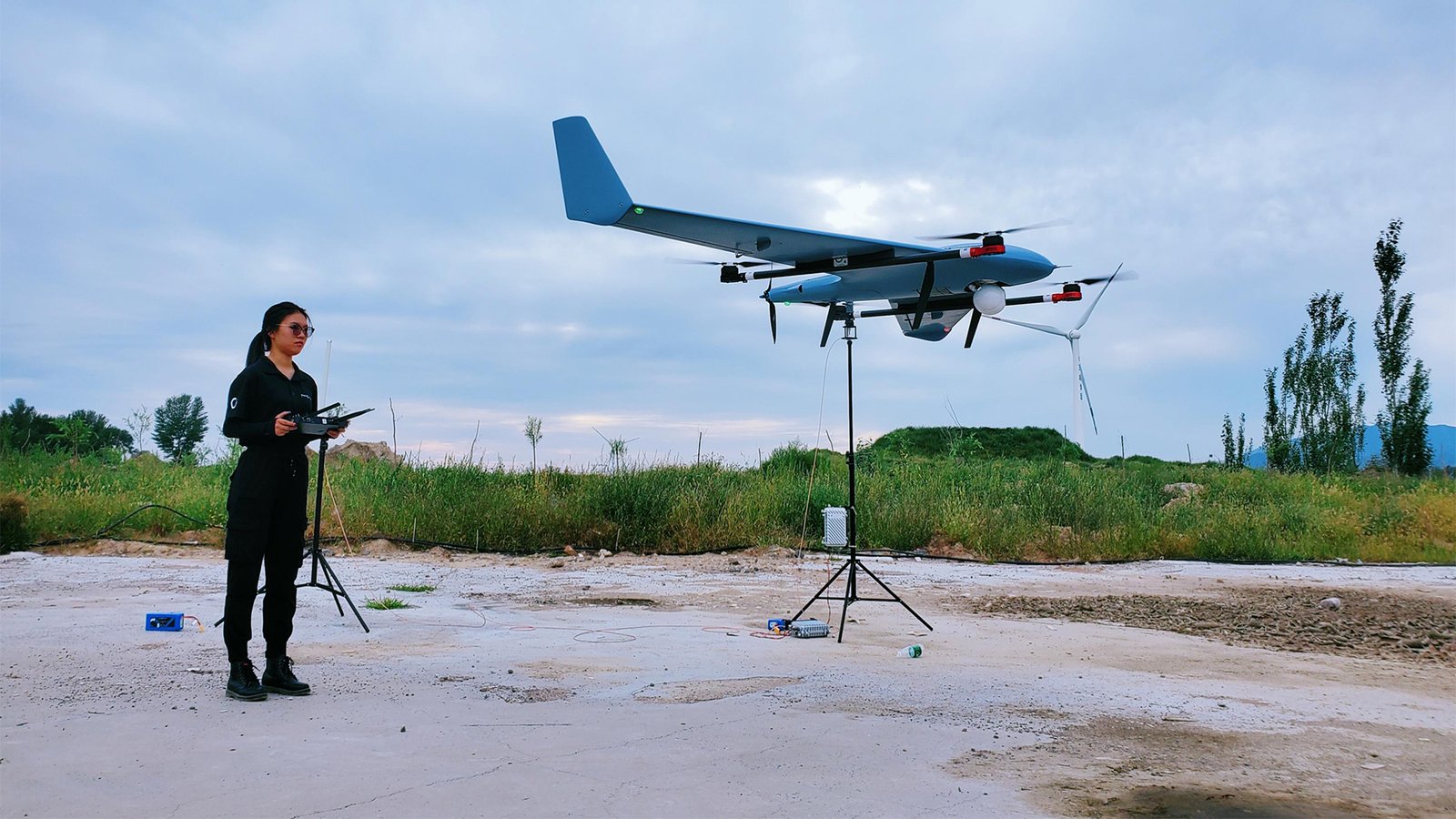
Architecture & Implementation
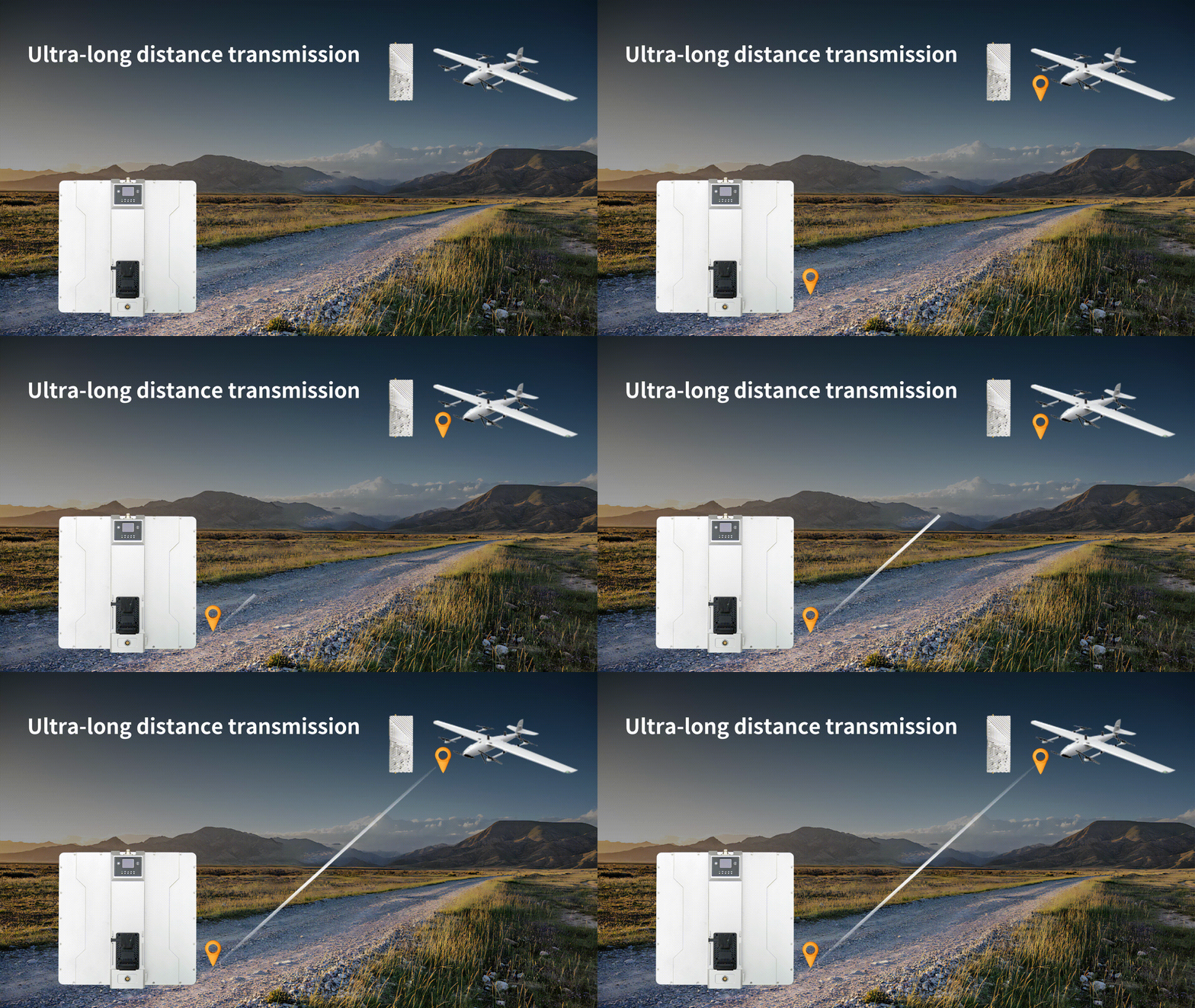
High-gain directional antennas—parabolic dishes or planar arrays—are installed at elevated positions to exploit line-of-sight transmission beyond Earth’s curvature. When paired with antenna tracking systems, these stations maintain precise alignment with airborne assets.
Case Study: An offshore wind farm 100km from shore deploys a relay station on a mountain-top tower at the midpoint, using 1.4GHz or 4–6GHz for two-stage transmission.
- Station placement accounts for Earth’s curvature and terrain elevation
- Power supply reliability critical—SoarApex power stations for off-grid locations
- Weatherproofing to IP65/IP67 for outdoor durability
- Integration with command control terminals for centralized management
Key Equipment Selection Guide
Selecting the right hardware components is essential for building a reliable 100Km Wireless UAV Video Data.
Frequency Band
1.4GHz or 600MHz preferred. Avoid crowded 2.4GHz/5.8GHz consumer bands to ensure regulatory compliance and interference immunity.
Transmission Power
Onboard/Portable: ≥10W. Ground Fixed: ≥20W. Power is the key to overcoming free-space loss—10W is the safety margin baseline for 100km Wireless UAV Video Data links.
Modulation Technology
COFDM/OFDM provides strong resistance to multipath effects, making it ideal for NLOS and complex electromagnetic environments.
Antenna Type
High-gain directional antennas required. Parabolic antennas offer maximum gain. Yagi antennas provide balanced alternatives. All require precise alignment via antenna tracking systems.
Protection Level
IP65/IP67 rating for outdoor use. Resistant to rain, dust, and salt spray. Wide temperature range: -40°C to +85°C. Essential for maritime and harsh environments.
Power Supply
Remote relay stations require reliable power. SoarApex power stations provide portable, high-capacity energy solutions for off-grid BVLOS operations.
Application Scenarios
Real-world deployment strategies for 100Km Wireless UAV Video Data systems across industrial, maritime, and emergency domains.
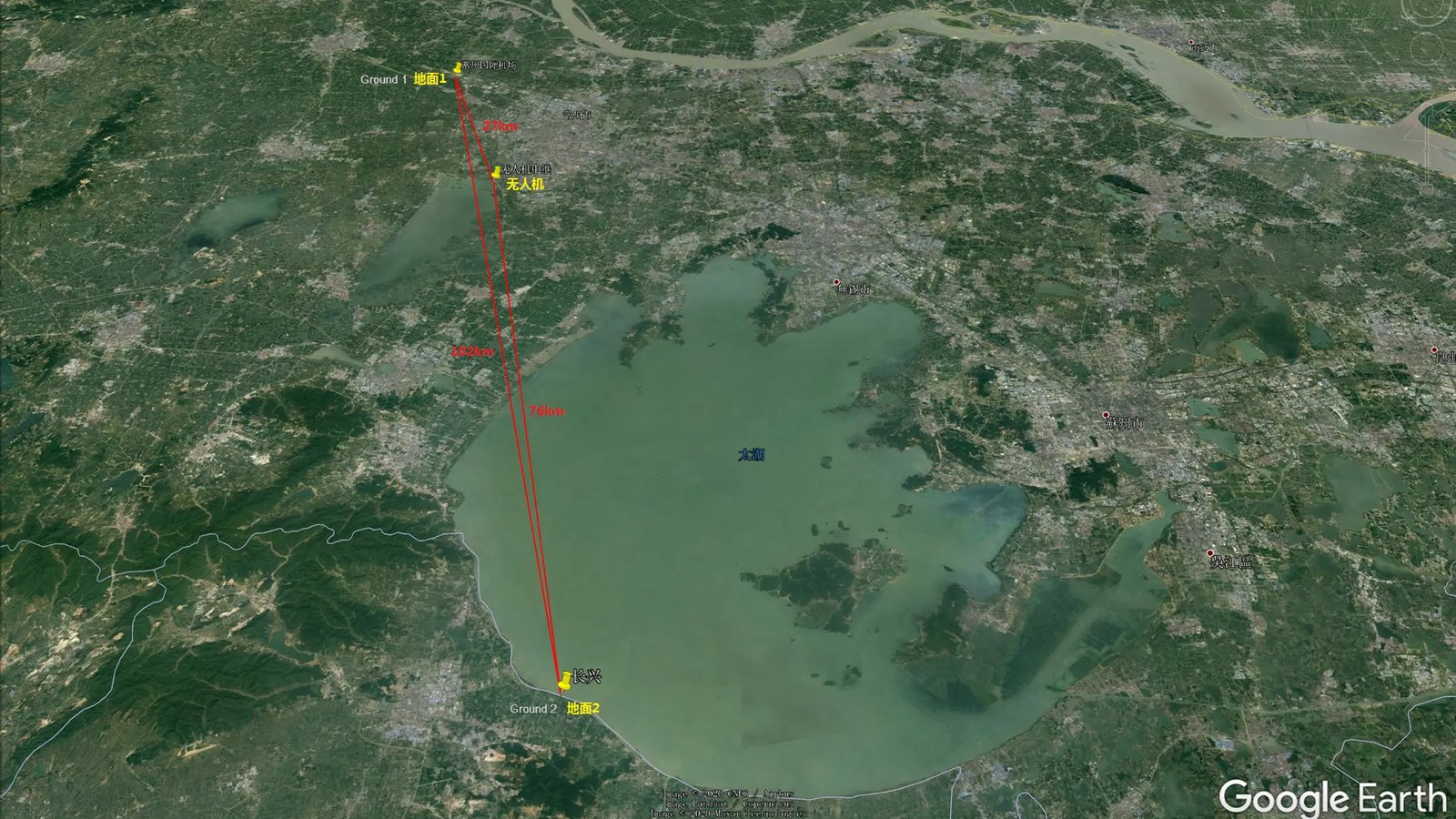
Industrial Drone Inspection
Equip the drone with a 10W 1.4GHz image transmission radio and pair with a ground station featuring a high-gain antenna. For VTOL fixed-wing platforms, extended flight endurance complements long-range datalink capability.
If terrain obstruction is severe, deploy a relay drone to hover at a high point for signal forwarding—particularly effective for pipeline corridors through mountainous terrain.
Critical Consideration
Always reserve sufficient Link Budget margin, accounting for atmospheric attenuation and vegetation cover that significantly impact signal strength at 100km.
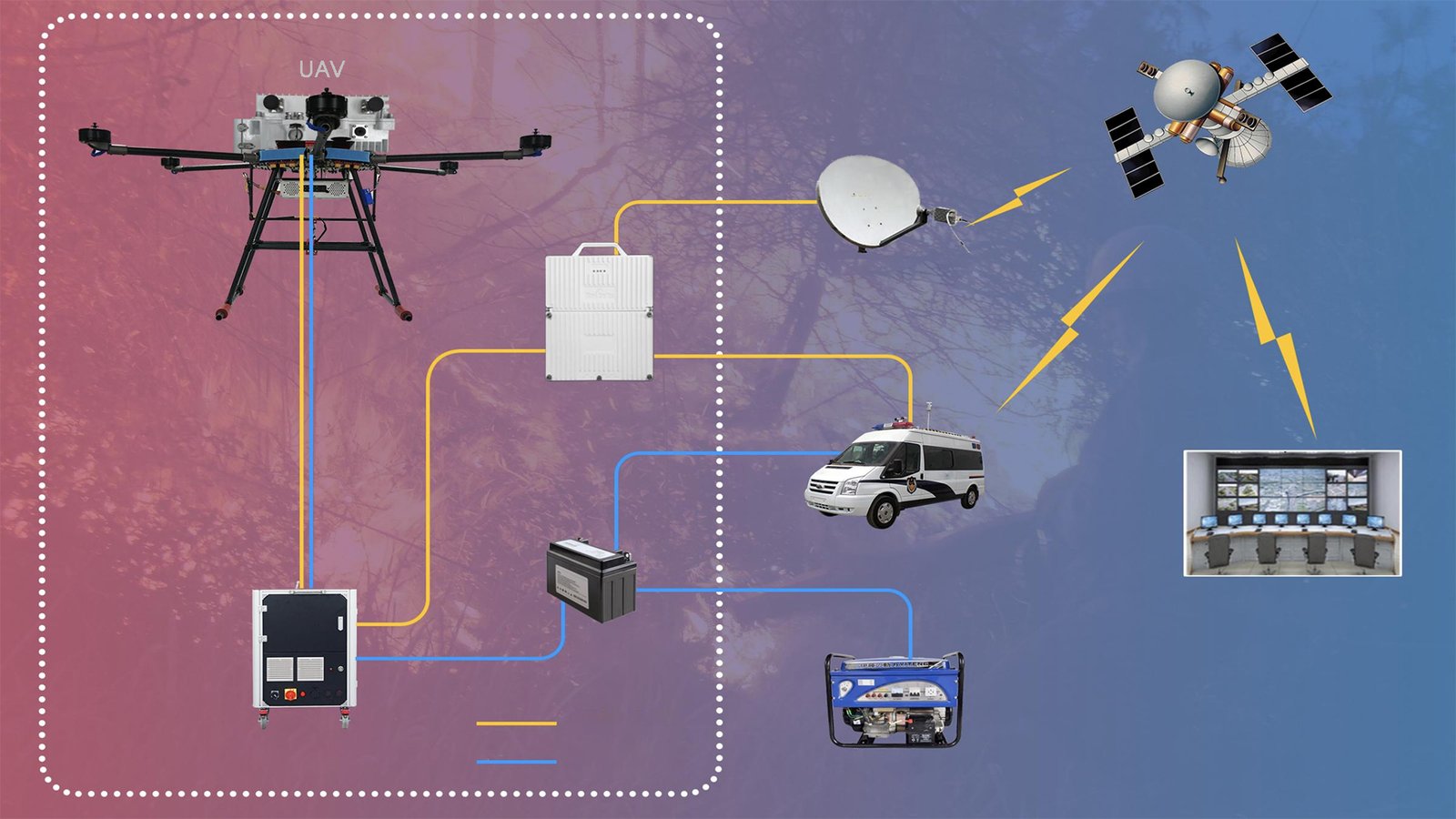
Maritime & Lake Communication
Maritime environments present unique challenges for 100Km Wireless UAV Video Data systems. Sea surface reflections create severe multipath interference, degrading signal quality and reducing effective range.
Implementation Strategy
Use COFDM equipment with advanced anti-multipath algorithms. For distances exceeding 50km, establish a relay station on an island or offshore tower midpoint. Multi-rotor UAV drones can serve as temporary airborne relays when fixed infrastructure is unavailable.
Emergency Command & Border Patrol
Rapidly deployable Mesh self-organizing network base stations—vehicle-mounted or backpack-portable—enable teams to establish temporary networks within minutes.
- “In-Motion Communication”: Vehicles maintain connectivity while moving, with automatic link reconstruction
- Rapid Deployment: Backpack units operational within 5 minutes of arrival
- Interoperability: Integrates with command control terminals and antenna tracking systems
- Scalability: Networks expand from 2 nodes to 200+ nodes as operations scale
Combined with portable power stations, these systems provide fully autonomous communication in areas without grid infrastructure.
Common Misconceptions & Risk Warnings
Implementing a 100Km Wireless UAV Video Data requires realistic expectations and careful planning.
Myth: Single-Hop 100km is Reliable
Unless over extremely open sea with extremely high-gain antennas, single-hop 100km is highly susceptible to Earth curvature and terrain undulations. Multi-hop relay is the more robust engineering choice.
Bandwidth vs. Distance Trade-off
The farther the distance, the lower the SNR and available bandwidth. A 100km link may only sustain 4–10Mbps. Compress video to 1080P rather than attempting 4K over long distances.
Regulatory Compliance
Although 1.4GHz is designated for industrial private networks, operators must confirm filing requirements with local radio regulatory authorities to avoid illegal frequency occupation.
Summary & Recommendations
For a 100Km Wireless UAV Video Data, the combination of “1.4GHz frequency band + 10W or higher power + Mesh multi-hop relay” represents the most mature and reliable industry solution.
Deployment Strategy
Fixed Point-to-Point: For permanent installations (offshore wind farms, border towers), set up directional relays at high points with antenna tracking systems for precise alignment.
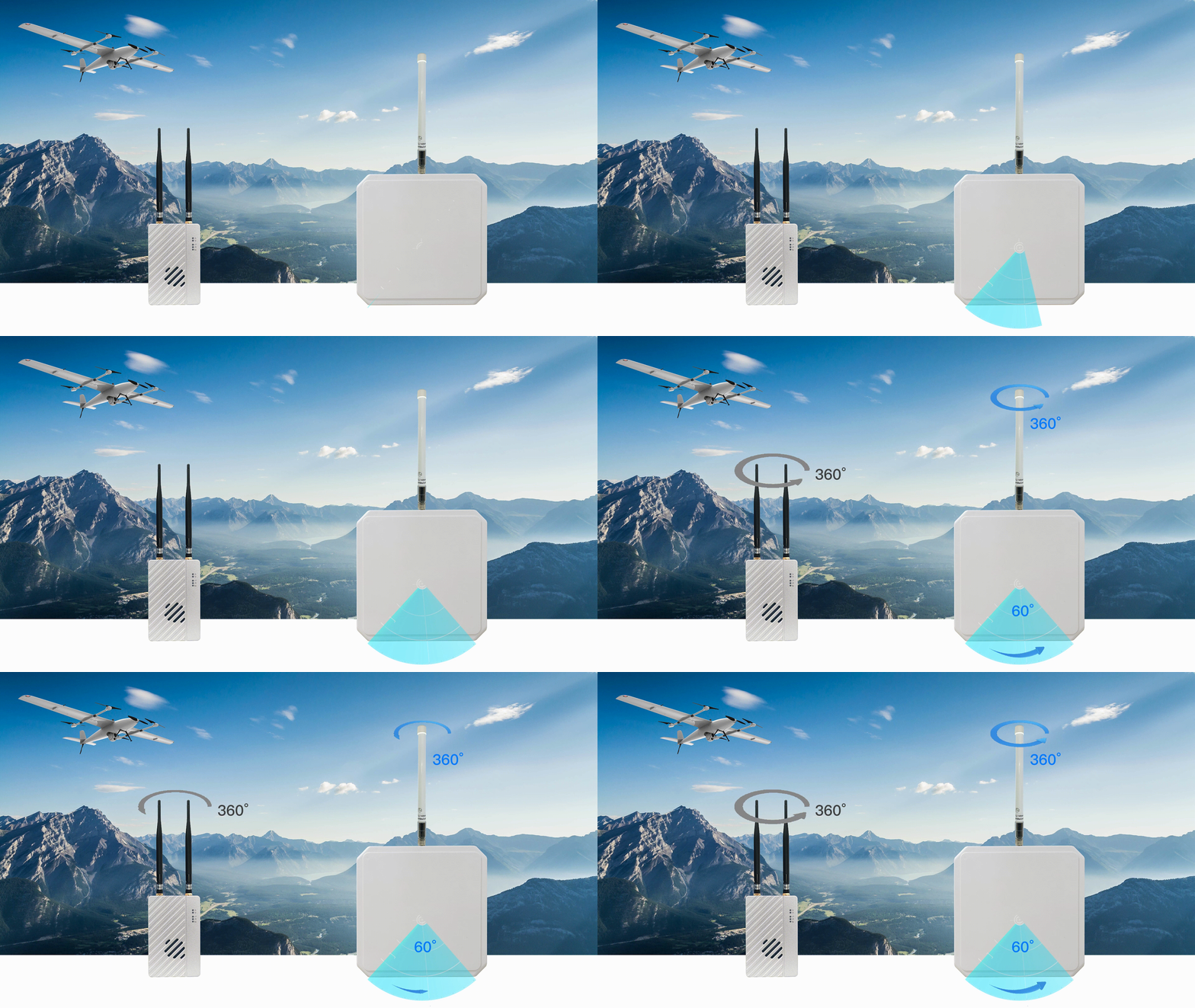
Mobile Platforms: For VTOL fixed-wing and multi-rotor UAV operations, choose self-organizing network devices supporting fast self-healing and dynamic topology.
Power Infrastructure: Remote relay stations require reliable energy. SoarApex power stations provide the independence needed for off-grid BVLOS nodes.
- Directional antennas at elevated positions maximize line-of-sight
- Mesh topology ensures redundancy and self-healing
- COFDM modulation resists multipath in complex environments
- 1.4GHz band balances range, penetration, and regulatory compliance
Related SoarApex Systems
Build a complete long-range unmanned communication ecosystem with our integrated solutions.
External Resources
Technical references and industry standards for 100Km Wireless UAV Video Data and BVLOS UAV communications.
Comprehensive overview of beyond visual line of sight aviation regulations and communication technologies.
Technical foundation of self-organizing network relay architectures for long-range data transmission.
Essential calculations for planning 100km wireless data links and predicting signal strength at range.
Coded Orthogonal Frequency-Division Multiplexing modulation powering anti-multipath transmission.
International Telecommunication Union standards for radio frequency spectrum allocation and usage.
Deploy Your 100km Wireless Data Link
Contact SoarApex today to discuss your BVLOS communication requirements. Our engineering team specializes in custom long-range datalink solutions for industrial UAV, USV, and UGV applications.
Request a Quote